Is STP in Insurance a reality or a myth?

Kanchana Vijayakumar
Head of Product & AI, BluePond.AI
The illusion of end-to-end automation
Straight Through Processing, or STP, has become a magic phrase in insurance boardrooms. The concept is simple: submissions come in, quotes go out, policies are issued, and claims are processed, all without human involvement. Fully touchless. Seamless. Scalable.
The problem is, the closer you get to actual operations, especially in commercial and specialty P&C, the more this vision starts to fall apart.
Despite years of tech investment, STP remains stubbornly out of reach. And it’s not due to a lack of ambition. It’s because insurance processes, particularly in underwriting and claims review, are layered, judgment-driven, and document-heavy. They were never built to be automated from start to finish.
Why STP in P&C still fails to deliver
There are three reasons why STP often breaks down before it even gets going.
- Document complexity: Insurance documents are unpredictable. Underwriters and brokers regularly deal with unstructured schedules, ACORDs and other scanned PDFs in varying formats, complex loss runs (single carrier, multi-carrier, multi-LoB etc) with missing data, and endorsements buried in email threads. There’s no such thing as standard input.
- Nuanced language: Coverage language is rarely clean or templated. Most policies have bespoke clauses or negotiated endorsements, which, by design, defy automation.
- Judgment calls: Much of what makes insurance work is human judgment. Risk appetite, historical claims context, competitive positioning, these aren’t inputs you feed into a rule engine; they’re nuanced decisions shaped by experience of the underwriter or claims adjuster.
So, what does this mean for the insurance industry or for those trying to automate it? It means the goalpost needs to shift. From full automation to intelligent augmentation.
Accuracy ≠ Precision
Many AI solutions in the market today boast accuracy figures in the 90% range. It sounds impressive until you unpack what it truly means.
Imagine you're running an AI model to support new business underwriting. It’s designed to extract key fields from broker submissions and emails: insured and location information, loss history, perils covered and other coverage details.
Now, let’s say the model is “90% accurate.” It accurately extracts the standard fields such as the names, the dates, prior premium etc. But it misses one location detail or a loss information. A line buried on a 100 location schedule or a 20 page loss run.
That one miss changes the entire risk profile. It’s no longer a mid-sized manufacturer with standard liability. It’s a site with high risks from prior losses or catastrophes. The model was accurate on the surface, but not precise. And now the business is holding a policy it shouldn’t have written.
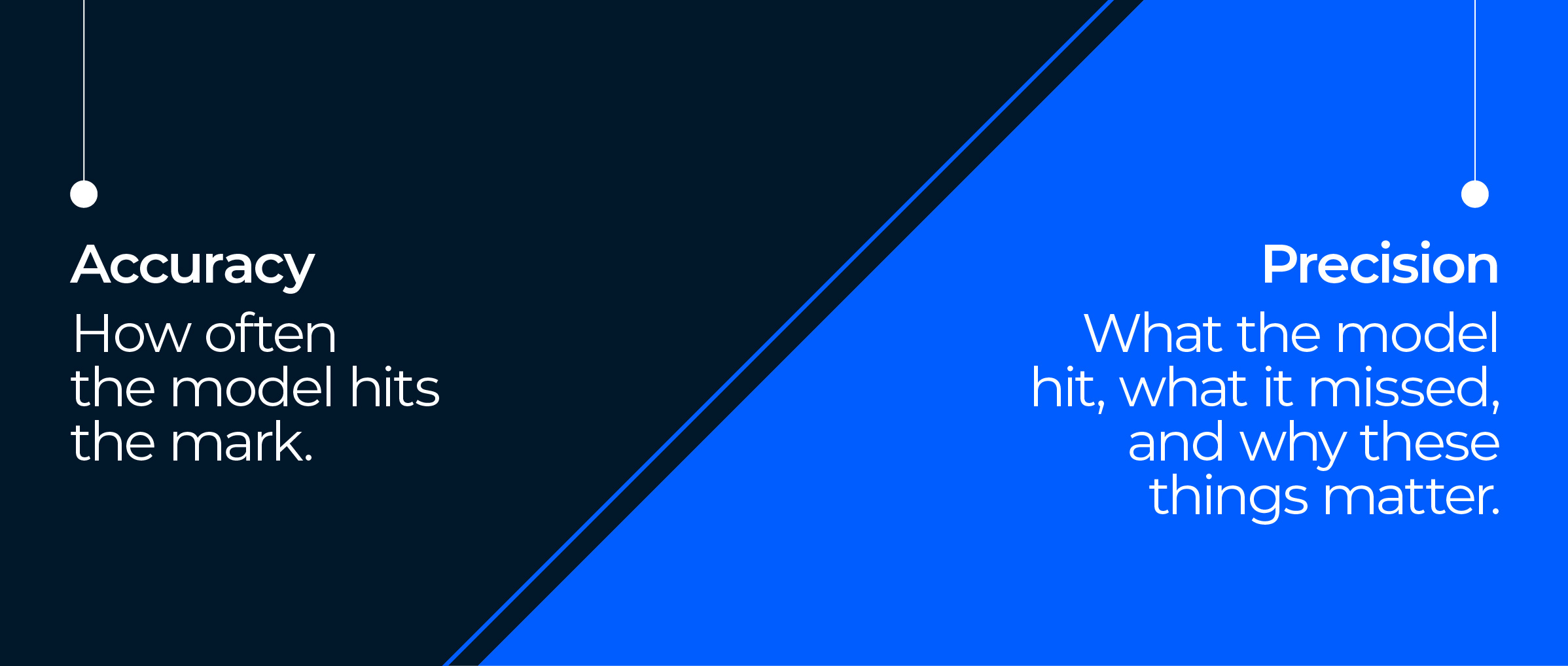
That’s the difference. Accuracy tells you how often the model hits the mark.Precision tells you exactly what it hit, what it missed, and why these things matter.
And in underwriting, especially when large limits and negotiated clauses are involved, precision isn't an option; it's a necessity.
The false comfort of 80–90% accuracy
That comfort we feel when we see “90% accuracy” in a vendor slide? It’s misplaced because it assumes all errors carry the same weight.
But in insurance, the 10% the system gets wrong isn’t a rounding error. It’s where the risk lives.
We’ve seen models that parse the obvious fields perfectly but overlook that one clause extending coverage to an additional insured or altering the definition of an occurrence. These aren’t edge cases. They’re the places underwriters are taught to double-check because that’s where the liability hides.
Let us look at a couple of real-world examples:
- A 90%-accurate underwriting-review system missed a custom water-backup exclusion. That alone created a $200K coverage gap, undetected until loss.
- In claims intake, a model misclassified a bodily-injury claim because it didn’t pick up nuances in the FNOL narrative. The result? Misrouted severity, ultimately costing six figures.
If your AI model can’t flag which 10% is wrong, your team starts ignoring the whole output. That’s automation breakdown.
Without a system that says, “we’re 99% sure on this, but only 60% on that,” humans have no way of knowing what to trust. And when trust breaks, the whole workflow collapses.
Progressive STP: A smarter and safer path
Rather than chasing full automation, many carriers and brokers are moving toward progressive STP: A more measured, confidence-led approach.
Here’s what it looks like in practice:
- You start with 100% human-in-the-loop. Every AI output is reviewed.
- Over time, the system learns which fields it consistently extracts accurately.
- The automation begins to scale, not because someone “switched it on,” but because the team sees where the system is reliable.
- Low-confidence output is flagged for human review, while high-confidence output flows straight through.
This builds trust naturally. You’re not asking teams to bet their license on a black box. You’re showing them where the system can help and letting them stay in control.
Humanizing AI isn’t optional, it’s the only way forward
If there’s one thing that defines successful AI adoption in insurance, it’s this: Humans stay in the loop. But not as a failsafe. As a design principle.
That means AI systems should:
- Score every field, not just the document as a whole.
- Show where the data was extracted from with full traceability.
- Offer override and escalation workflows.
- Learn from corrections in a closed loop.
AI doesn’t replace underwriting expertise or claims intuition. It amplifies it by taking care of the repeatable, surfacing the unusual, and making the expert’s job more focused.
It becomes a colleague you can trust, not a risk.
Where STP actually works: Real-world use cases
The truth is, STP may not be fully real. But targeted, precision-first automation? That’s already working and driving value.
Underwriting
- Triage submissions: AI flags low-risk, data-complete accounts for quick approval; flags others for manual review.
- Manuscript review: AI looks at manuscripts or follow-form policies and identifies clauses that do not align to insurer/MGA underwriting guidelines. The underwriters can focus on reviewing the variations alone.
Claims intake
- FNOL triage: AI extracts loss type, policy number, incident date, location information and routes high-severity or incomplete cases directly to adjusters. Low-severity claims triage can be automated, saving time.
- Coverage verification: AI validates the loss cause against the coverages in the policy and confirms claim validity. Complex multi-peril cases can be directed to adjusters for review.
These are the wins that matter. Not "100% STP," but 100% visibility, repeatable quality, and better outcomes across every touchpoint.
The precision-first future
STP may have dominated the narrative for the past decade, but it’s no longer the endgame. The real shift is toward precision.
Because precision isn’t about getting everything right. It’s about knowing exactly what’s right, what’s uncertain, and what needs attention. It’s about surfacing risk, not just processing data.
The future of P&C operations isn’t fully automated. It’s fully aware. Designed to be explainable. Designed for trust. And designed around the people who make the hardest calls.
SENSE: Intelligence without compromise
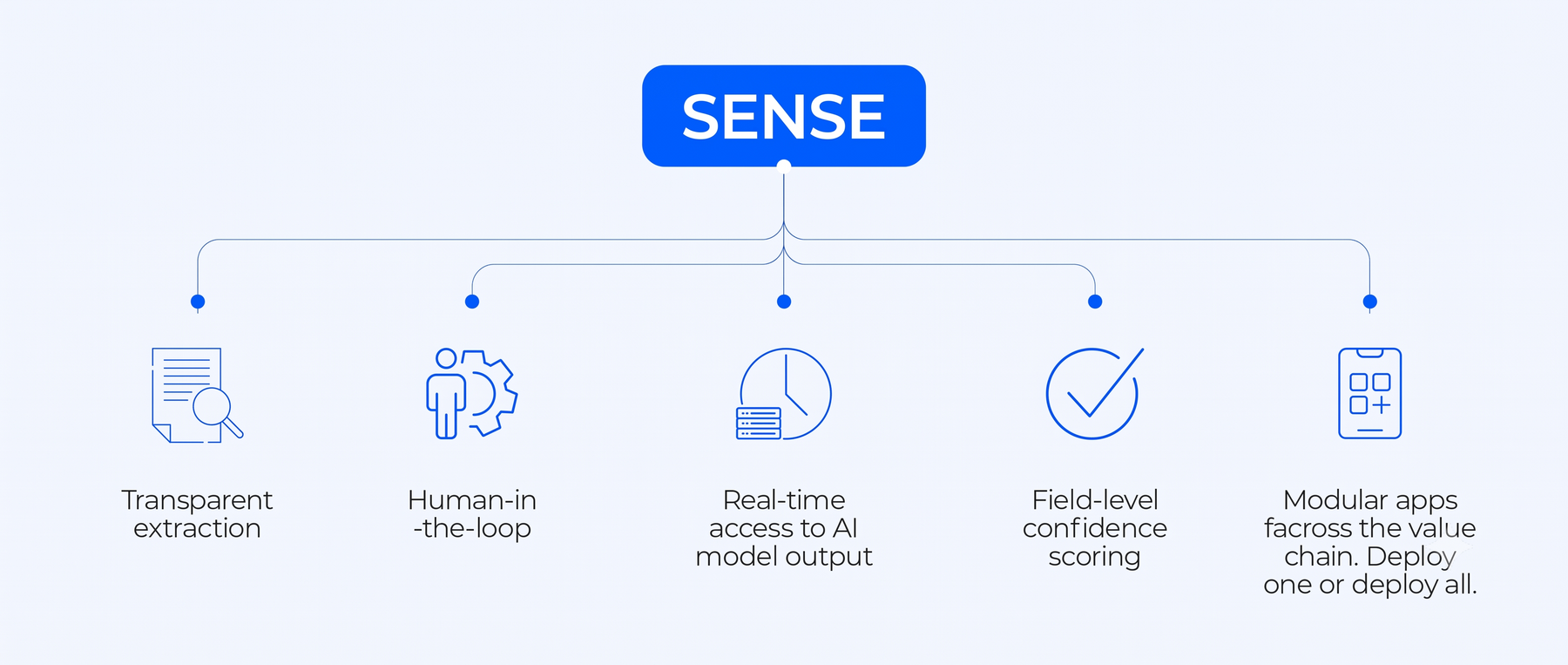
This is why we built SENSE, a precision-first platform purpose-built for P&C insurance workflows.
With SENSE, you get:
- Transparent extraction from complex, multi-format documents.
- Human-in-the-loop design that puts your experts in charge, not out of the loop.
- Real-time access to AI model output at all times with a clear view of model output vs Human-in-the-loop reviewed output.
- Field-level confidence scoring, so you know what’s safe to trust and what needs eyes.
- Modular Sense applications for underwriting, claims triage, and submission review. Deploy one or deploy all.
SENSE doesn’t try to force STP where it doesn’t belong. It delivers real intelligence, tailored to the pace and complexity of your operations. It’s transformation on your terms, built to deliver intelligence without compromise.