From 'black box' to 'glass box': Building transparency into insurance AI

Nimish NK
Operations Manager, BluePond.AI
For years, insurance operations have relied on processes that are complex and fragmented. New AI solutions promise to speed up these processes and scale efficiency, but they also introduce a new challenge: their outputs often behave like a black box.
Brokers, underwriters, and claims managers receive answers and recommendations, but they cannot see how these were produced. Without clarity, trust erodes, adoption stalls, and the efficiency gains promised by automation fail to materialize.
BluePond.AI believes the future of insurance AI is not about producing more opaque solutions, but about making every step transparent, traceable, and reliable. Instead of a black box, we build systems that operate like a glass box: visible, auditable, and accountable.
Why 'black box' tech fails in insurance
The insurance industry is built on risk assessment, compliance, and tons of documentation. Opaque AI solutions create tangible risks and limitations, such as:
- No visibility into the logic: If a broker cannot trace why a coverage change was flagged, they cannot confidently communicate it to the clients or carriers.
- Errors hidden in plain sight: Small shifts in endorsement language, such as replacing “shall” with “may”, can have a material impact. If these go undetected, they can expose brokers to E&O claims and damage client trust.
- Compliance challenges: An AI tool denies a claim, stating that it is outside policy coverage, but doesn’t provide a traceable reasoning path. Regulators or auditors reviewing a denied claim may question the decision. Lack of transparency can lead to compliance risks or necessitate labor-intensive manual checks.
- Slow adoption: Regulators, compliance teams, and clients are naturally skeptical of opaque systems. If transparency is lacking, adoption slows, regardless of how powerful the AI tool appears.
- Reduced continuous improvement: One of the biggest advantages of AI is that it is constantly learning and improving. But if a system hides its reasoning, it makes it harder to refine or improve its LLMs based on feedback from professionals and real-world outcomes.
A transparent approach to AI in insurance
BluePond.AI has designed its platform with transparency as a core principle. This comes to life with P&C Intelligence, confidence scoring, and a modular architecture. Each element ensures that outputs are not only accurate, but also explainable and auditable.
Making AI explainable with the P&C Intelligence
The P&C Intelligence is not just a workflow. It is the architecture of transparency, breaking down insurance documents into smaller, auditable stages so users can see not just what the system outputs, but how it got there.
- Document intelligence: Reads, interprets, and structures information from policies, quotes, schedules, and other insurance documents. It provides traceability to the source documents when we need it.
- Language intelligence: Detects nuanced changes in phrasing or terminology, surfacing even the most minute variations that materially impact coverage. It exposes how coverage changes are interpreted, not just flagged.
- Process intelligence: Aligns AI outputs with insurance workflows and business rules, ensuring recommendations are actionable and relevant. It showcases how raw findings are transformed into structured, broker-facing insights.
Because the P&C Intelligence is layered, every insight can be traced back to its origin, every error can be localized to the right stage, and every output can be explained step-by-step. This is what transforms AI from a black box into a glass box.
Making certainty visible with confidence scoring
Confidence scoring makes certainty explicit. Every AI output, whether it is an extracted value, a compared policy, a processed claim, or a recommendation, comes with a measurable score of confidence.
- Visible reliability: High scores indicate results the system is very confident in; low scores surface areas where users should take a closer look.
- No hidden errors: Instead of presenting all outputs as equally valid, confidence scoring distinguishes between strong signals and weak ones.
- Guided action: Professionals can decide when to trust the AI directly and when to intervene, saving time without losing control.
- Auditability: Confidence levels provide an evidence trail for compliance, enabling insurers and brokers to demonstrate not just what was decided, but how it was evaluated.
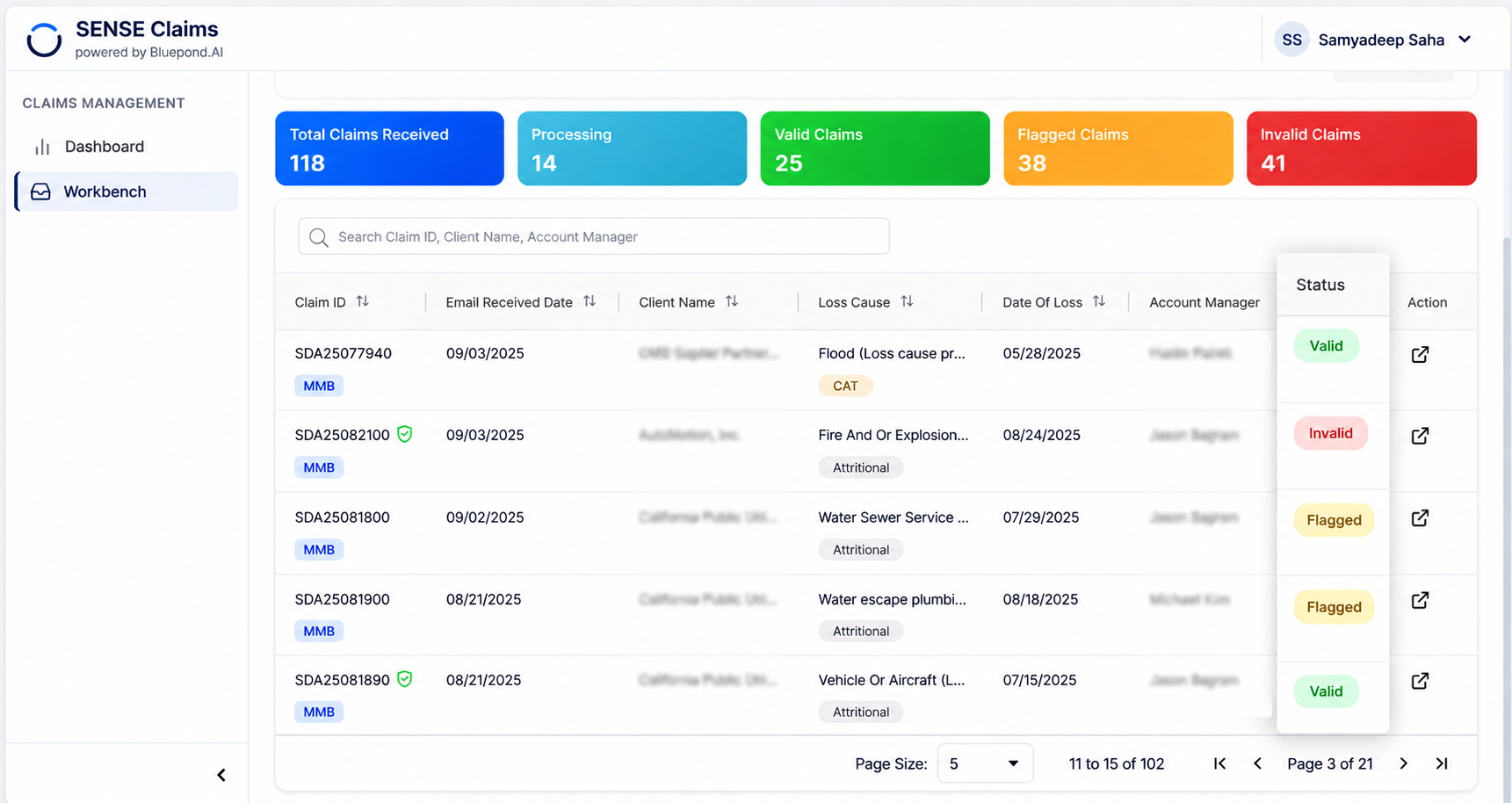
Here’s how it looks in practice:
In our SENSE Claims, claims marked in green can be approved with ease, while those in red are flagged for review. The color-coding makes transparency instant and actionable, turning confidence into a visible signal for decision-making.
Making complex workflows transparent with Agentic AI
Finally, transparency is reinforced with an agentic AI approach. Instead of relying on one monolithic model, tasks are orchestrated across specialized agents such as extraction agents, comparison agents, and recommendation agents, each with a defined role.
This makes automation with AI inherently traceable.
- Defined accountability: Each agent has a clear responsibility, so errors or anomalies can be localized to the exact stage of the workflow.
- Step-by-step visibility: Because agents work sequentially, users can follow the reasoning path from raw data to the final recommendation.
- Transparent outcomes: Outputs are not just results, but a composite of explainable actions performed by each agent.
By turning opaque processes into auditable chains of reasoning, Agentic AI ensures that automation does not replace human trust; it strengthens it.
From 'black box' to 'glass box': Why transparency wins
Insurance is built on trust, accountability, and clarity. If AI cannot live up to those same standards, it will never be more than a curiosity. Transparency is not an optional feature of AI in insurance; it is the foundation that determines whether the technology drives adoption, scales with confidence, and delivers lasting value.
BluePond.AI believes transparency is what transforms AI from a risk into a competitive advantage. By making certainty visible, automation traceable, and every decision explainable, we turn AI from a black box into a glass box. That is how insurers, brokers, and claims professionals can embrace AI with confidence, and how the industry moves from promise to practice.

Nimish NK is a seasoned insurance professional with over 13 years of experience across InsureTech, broking, TPA, and carrier operations. He currently leads Operations and Product Development at BluePond.AI, working to bridge the gap between technology, operations, and client needs to drive innovation and efficiency in the P&C insurance space.